call 800.262.2235 or Send Us An Email Click here to Find a Partner Clinic: Learn more about our Resident Program: |
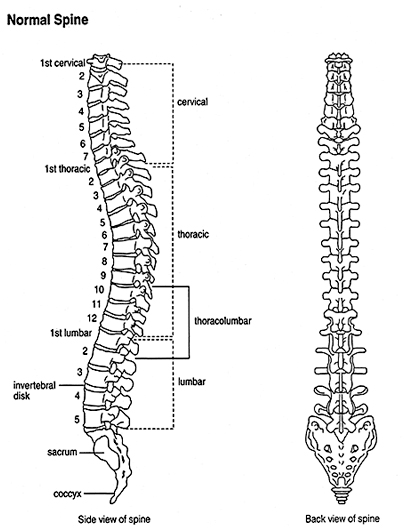
Overview of Scoliosis in Children & AdolescentsScoliosisPublication Date: July 2008 Questions and Answers about Scoliosis in Children and AdolescentsThis booklet defines scoliosis and provides information about how it is diagnosed and treated in children and adolescents. You may be interested in contacting one or more of the organizations listed at the end of the booklet for more information. What Is Scoliosis?Scoliosis is a musculoskeletal disorder in which there is a sideways curvature of the spine, or backbone. The bones that make up the spine are called vertebrae. Some people who have scoliosis require treatment. Other people, who have milder curves, may need to visit their doctor for periodic observation only. "Does Scoliosis Have To Be Treated? What Are the Treatments?" describes how doctors decide whether or not to treat scoliosis. Who Gets Scoliosis?People of all ages can have scoliosis, but this booklet focuses on children and adolescents. Of every 1,000 children, 3 to 5 develop spinal curves that are considered large enough to need treatment. Adolescent idiopathic scoliosis (scoliosis of unknown cause) is the most common type and occurs after the age of 10. Girls are more likely than boys to have this type of scoliosis. Because scoliosis can run in families, a child who has a parent, brother, or sister with idiopathic scoliosis should be checked regularly for scoliosis by the family doctor. Idiopathic scoliosis can also occur in children younger than 10 years of age, but is very rare. Early onset or infantile idiopathic scoliosis occurs in children younger than 3 years old. It is more common in Europe than in the United States. Juvenile idiopathic scoliosis occurs in children between the ages of 3 and 10. What Causes Scoliosis?In 80 to 85 percent of people, the cause of scoliosis is unknown; this is called idiopathic scoliosis. Before concluding that a person has idiopathic scoliosis, the doctor looks for other possible causes, such as injury or infection. Causes of curves are classified as either nonstructural or structural.
How Is Scoliosis Diagnosed?Doctors take the following steps to evaluate patients for scoliosis:
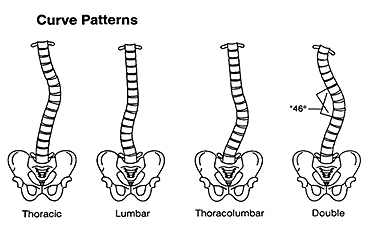
Doctors group curves of the spine by their location, shape, pattern, and cause. They use this information to decide how best to treat the scoliosis.
Does Scoliosis Have to Be Treated? What Are the Treatments?Many children who are sent to the doctor by a school scoliosis screening program have very mild spinal curves that do not need treatment. When treatment is needed, the doctor may send the child to an orthopaedic spine specialist. The doctor will suggest the best treatment for each patient based on the patient's age, how much more he or she is likely to grow, the degree and pattern of the curve, and the type of scoliosis. The doctor may recommend observation, bracing, or surgery.
Are There Other Ways to Treat Scoliosis?Some people have tried other ways to treat scoliosis, including manipulation by a chiropractor, electrical stimulation, dietary supplements, and corrective exercises. So far, studies of the following treatments have not been shown to prevent curve progression, or worsening:
Which Brace Is Best?The decision about which brace to wear depends on the type of curve and whether the patient will follow the doctor's directions about how many hours a day to wear the brace. There are two main types of braces. Braces can be custom-made or can be made from a prefabricated mold. All must be selected for the specific curve problem and fitted to each patient. To have their intended effect (to keep a curve from getting worse), braces must be worn every day for the full number of hours prescribed by the doctor until the child stops growing.
If the Doctor Recommends Surgery, Which Procedure Is Best?Many surgical techniques can be used to correct the curves of scoliosis. The main surgical procedure is correction, stabilization, and fusion of the curve. Fusion is the joining of two or more vertebrae. Surgeons can choose different ways to straighten the spine and different implants to keep the spine stable after surgery. (Implants are devices that remain in the patient after surgery to keep the spine aligned.) The decision about the type of implant will depend on the cost; the size of the implant, which depends on the size of the patient; the shape of the implant; its safety; and the experience of the surgeon. Each patient should discuss his or her options with at least two experienced surgeons. Patients and parents who are thinking about surgery may want to ask the following questions:
Can People With Scoliosis Exercise?Although exercise programs have not been shown to affect the natural history of scoliosis, exercise is encouraged in patients with scoliosis to minimize any potential decrease in functional ability over time. It is very important for all people, including those with scoliosis, to exercise and remain physically fit. Girls have a higher risk than boys of developing osteoporosis (a disorder that results in weak bones that can break easily) later in life. The risk of osteoporosis is reduced in women who exercise regularly all their lives. Also, weight-bearing exercise, such as walking, running, soccer, and gymnastics, increases bone density and helps prevent osteoporosis. For both boys and girls, exercising and participating in sports also improve their general sense of well-being. What Are Researchers Trying to Find Out About Scoliosis?Researchers are looking for the cause of idiopathic scoliosis. They have studied genetics, growth, structural and biochemical alterations in the discs and muscles, and central nervous system changes. The changes in the discs and muscles seem to be a result of scoliosis and not the cause. Scientists are still hopeful that studying changes in the central nervous system in people with idiopathic scoliosis may reveal a cause of this disorder.Researchers continue to examine how a variety of braces, surgical procedures, and surgical instruments can be used to straighten the spine or to prevent further curvature. They are also studying the long-term effects of both scoliosis fusion and the long-term effects of untreated scoliosis. Where Can People Get More Information About Scoliosis?National Scoliosis Foundation
This nonprofit voluntary organization provides pamphlets, a newsletter, and other information materials on childhood and adult scoliosis. The foundation also provides support group information and lists of doctors in each state who specialize in scoliosis. The Scoliosis Association, Inc.
This association publishes a quarterly newsletter and pamphlets on scoliosis. A single copy of its fact sheet is available free by sending a self-addressed, stamped envelope. The association also provides information about local chapters and support groups. Scoliosis Research Society
This is a professional organization for orthopaedic surgeons interested in scoliosis. It provides pamphlets about the diagnosis and treatment of scoliosis. A free pamphlet is offered on its Web site as well as through the mail. The society also can provide referrals to doctors. American Physical Therapy Association
The American Physical Therapy Association's brochure about scoliosis, in English or Spanish, is available by mail or through the Web site. AcknowledgmentsNIAMS gratefully acknowledges the assistance of Dr. Stuart Weinstein, Professor of Orthopedic Surgery, University of Iowa, in the preparation and review of this booklet, and Dr. John Lonstein, Department of Orthopaedic Surgery, University of Minnesota, and Dr. James Panagis, NIAMS, in the review of this booklet. The mission of the National Institute of Arthritis and Musculoskeletal and Skin Diseases (NIAMS), a part of the National Institutes of Health (NIH), is to support research into the causes, treatment, and prevention of arthritis and musculoskeletal and skin diseases, the training of basic and clinical scientists to carry out this research, and the dissemination of information on research progress in these diseases. The NIAMS Information Clearinghouse is a public service sponsored by the Institute that provides health information and information sources. Additional information can be found on the NIAMS Web site at www.niams.nih.gov. Information on bone and its disorders can be obtained from the NIH Osteoporosis and Related Bone Diseases ~ National Resource Center by calling (toll free) 800–624–BONE (2663) or by visiting its Web site at www.niams.nih.gov/bone. For Your InformationThis publication contains information about medications used to treat the health condition discussed in this booklet. When this booklet was printed, we included the most up-to-date (accurate) information available. Occasionally, new information on medication is released.For updates and for any questions about any medications you are taking, please contact U.S. Food and Drug Administration
For updates and questions about statistics, please contact Centers for Disease Control and Prevention’s National Center for Health Statistics
This booklet is not copyrighted. Readers are encouraged to duplicate and distribute as many copies as needed. Additional copies of this booklet are available from National Institute of Arthritis and Musculoskeletal and Skin Diseases (NIAMS)
|
||
|
|||